
Table of Contents
- At a Glance: Clearing Geauga County’s Toughest Invasives
- Reclaiming the Geauga County Landscape from Invasive Honeysuckle
- About BrushBoss: Northeast Ohio’s Land Management Experts
- Our Equipment and Service Standards
- Why Invasive Honeysuckle is a Crisis for Geauga County Estates
- The CAT 275 XE Advantage: Why Residential Equipment Fails
- Localized Removal: Russell, Bainbridge, and Burton Village Strategies
- Forestry Mulching vs. Manual Removal: A Permanent Solution?
- The BrushBoss Field Report: Real-World Geauga County Case Studies
- Frequently Asked Questions About Honeysuckle Removal in Ohio
- Limitations and Maintenance: What to Expect Post-Clearing
- Restore Your Geauga County Property to Its Former Glory
At a Glance: Clearing Geauga County’s Toughest Invasives
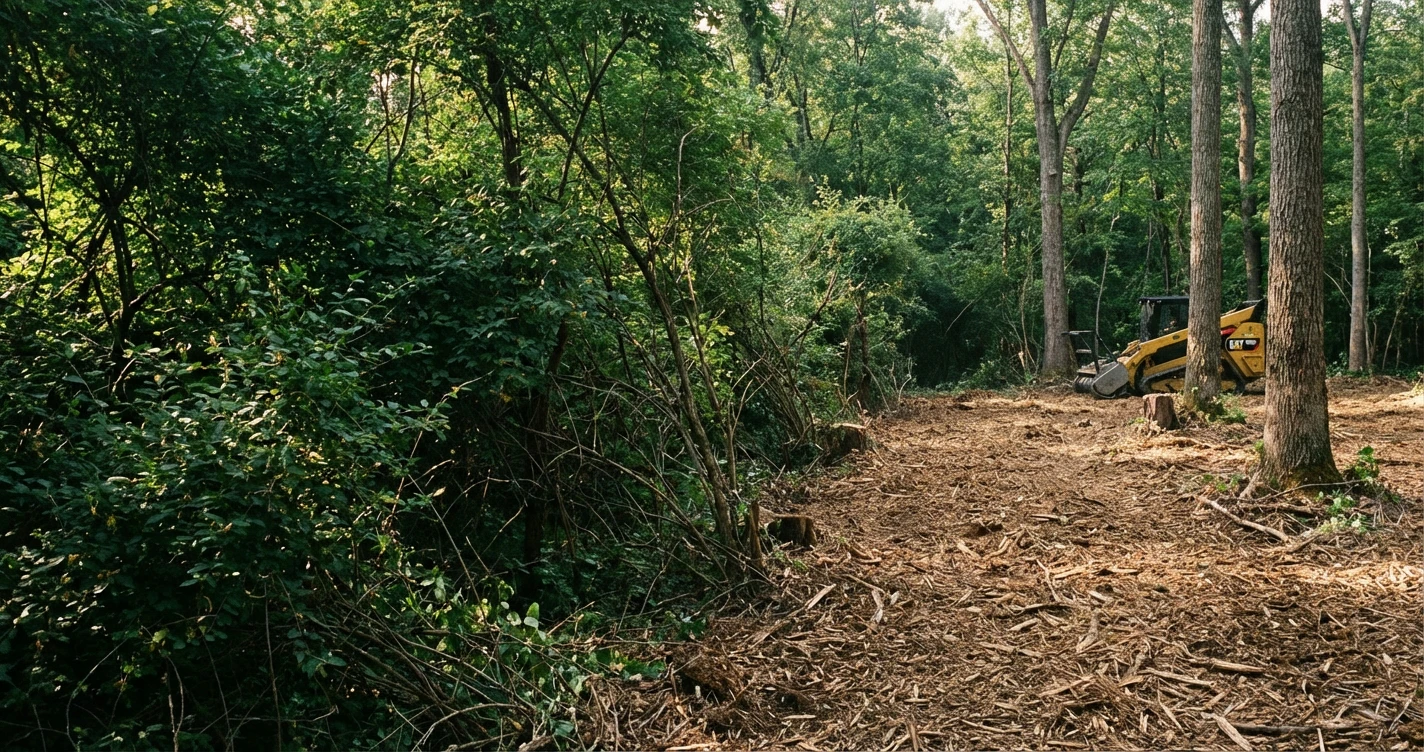
For property owners in Chesterland, where agricultural land meets forest edges, the “once and for all” approach of forestry mulching is a game-changer. We navigate the CAT 275 XE through tight timber stands with surgical precision, removing the invasive understory without damaging the high-value oaks and maples you want to keep. This mechanical solution is the most environmentally responsible way to restore the ecological balance of your land, providing immediate visual results and long-term land health.
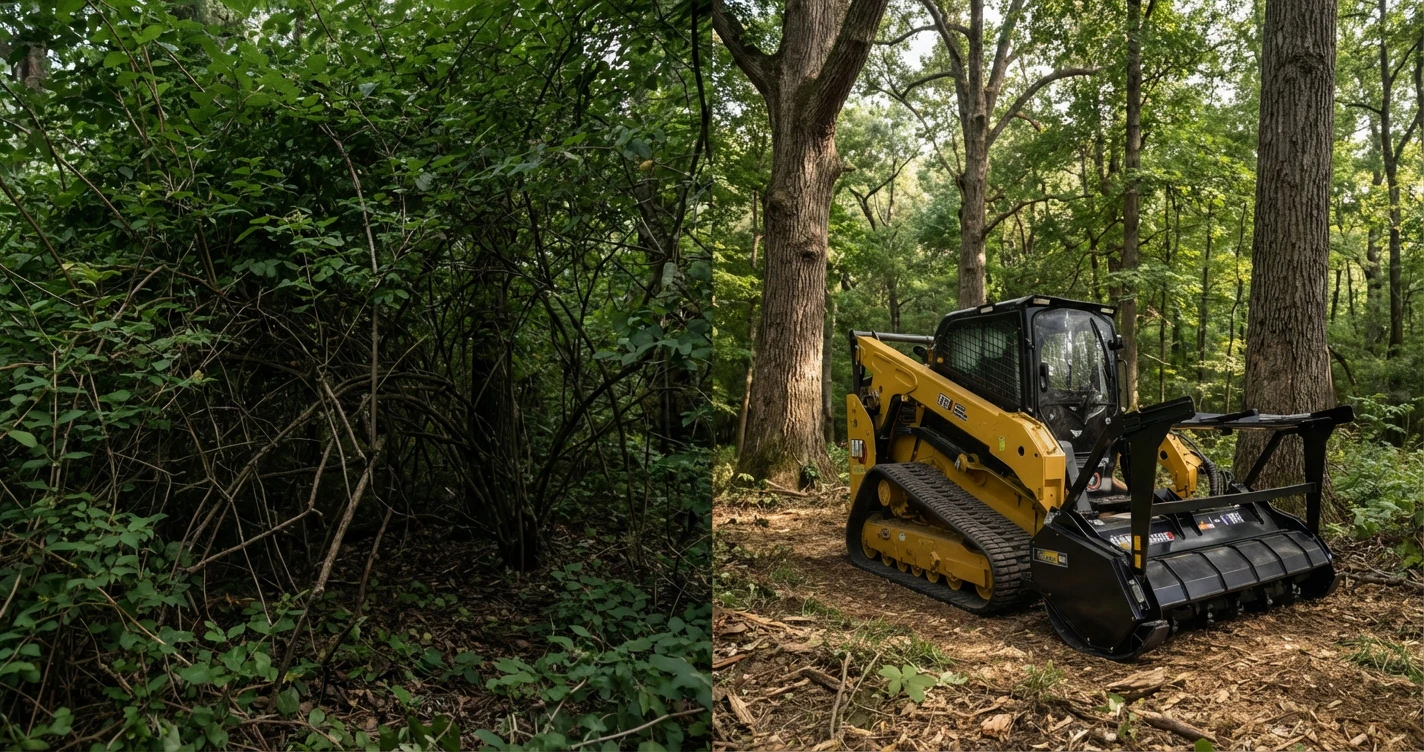
- The Problem: Amur and Morrow’s honeysuckle create an impenetrable “green wall” that acts as both a visual and biological barrier. We have found that these invasive species do more than just block scenic views; they kill native oak and maple seedlings by aggressively competing for sunlight and nutrients, effectively halting the forest’s natural regeneration.
- The Solution: Our approach utilizes the CAT 275 XE Land Management Edition, a specialized forestry machine designed for high-efficiency vegetation processing. This equipment grinds dense brush into a nutrient-rich mulch layer, which we have observed stabilizes the soil while returning organic matter to the earth, eliminating the need for hauling or burning.
- Service Areas: We deploy our specialized equipment specifically to Russell Village to reclaim the sightlines of estate hills, Gates Mills to clear wooded residential properties, and Middlefield to manage agricultural edges where invasive brush often encroaches on productive fields.
- Speed: Our mechanical process clears 2-5 acres of dense brush per day. In our analysis, this provides a significant advantage over manual crews, who typically require weeks of labor-intensive work to achieve the same results that we can produce in a fraction of the time.
- Outcome: The result is the immediate restoration of property aesthetics and “view sheds”—the visual corridors that define a landscape’s value. By removing the invasive wall, we transform overgrown, inaccessible thickets back into clean, usable land that is ready for recreation or natural regrowth.
Reclaiming the Geauga County Landscape from Invasive Honeysuckle
The most efficient method to remove honeysuckle in Geauga County is industrial forestry mulching, which processes the entire plant down to the root collar in a single pass. In our experience managing large estates, the aggressive growth of Lonicera maackii (Amur honeysuckle) creates a monoculture that chokes out native wildflowers and tree saplings within three years of establishment. For homeowners in Auburn, Chardon, and Parkman, this means a loss of property value and the disappearance of the iconic open hardwoods that define Northeast Ohio.
While many property owners attempt manual removal, the sheer biomass of mature honeysuckle stands—often 15 feet high with 20-foot spreads—makes hand-cutting futile for anything over half an acre. We have found that the “green wall” effect not only destroys the ecosystem but creates a visual barrier that makes 10-acre estates feel like cramped quarter-acre lots. BrushBoss helps owners reclaim their land using the same “boss-level” standards we apply to our high-end coatings work, ensuring a finish that transforms the landscape instantly.
About BrushBoss: Northeast Ohio’s Land Management Experts
As the founder of BrushBoss, I brought our reputation for meticulous, high-end property preservation from the painting industry into land management. Our clients in Northeast Ohio know us for our “boss-level” finish—a commitment to perfection that tolerates no shortcuts. When we saw our clients’ beautiful homes being swallowed by invasive brush, we expanded our operations to include industrial-scale land management, applying the same rigorous safety and quality protocols found in our OSHA-compliant coating projects.
We are not a landscaping crew with a rented skid steer; we are heavy equipment operators specializing in high-value property restoration. We understand that Geauga County estates require a delicate touch despite the heavy machinery used. Our transition into this sector was driven by a demand for professionalism: showing up on time, protecting the remaining trees, and leaving a site that looks manicured rather than mauled.
Our Equipment and Service Standards
Transparency Disclosure: BrushBoss owns and operates the CAT 275 XE Land Management Edition featured in this analysis. We do not rent inferior equipment. This machine is purpose-built for forestry applications, allowing us to guarantee specific production rates and finish quality.
While we strive for permanent eradication, we believe in honest expectations: forestry mulching destroys the existing plant, but the soil seed bank may produce new sprouts. A true “boss-level” result often involves a minor maintenance plan 12-24 months post-clearing to address dormant seeds.
Why Invasive Honeysuckle is a Crisis for Geauga County Estates
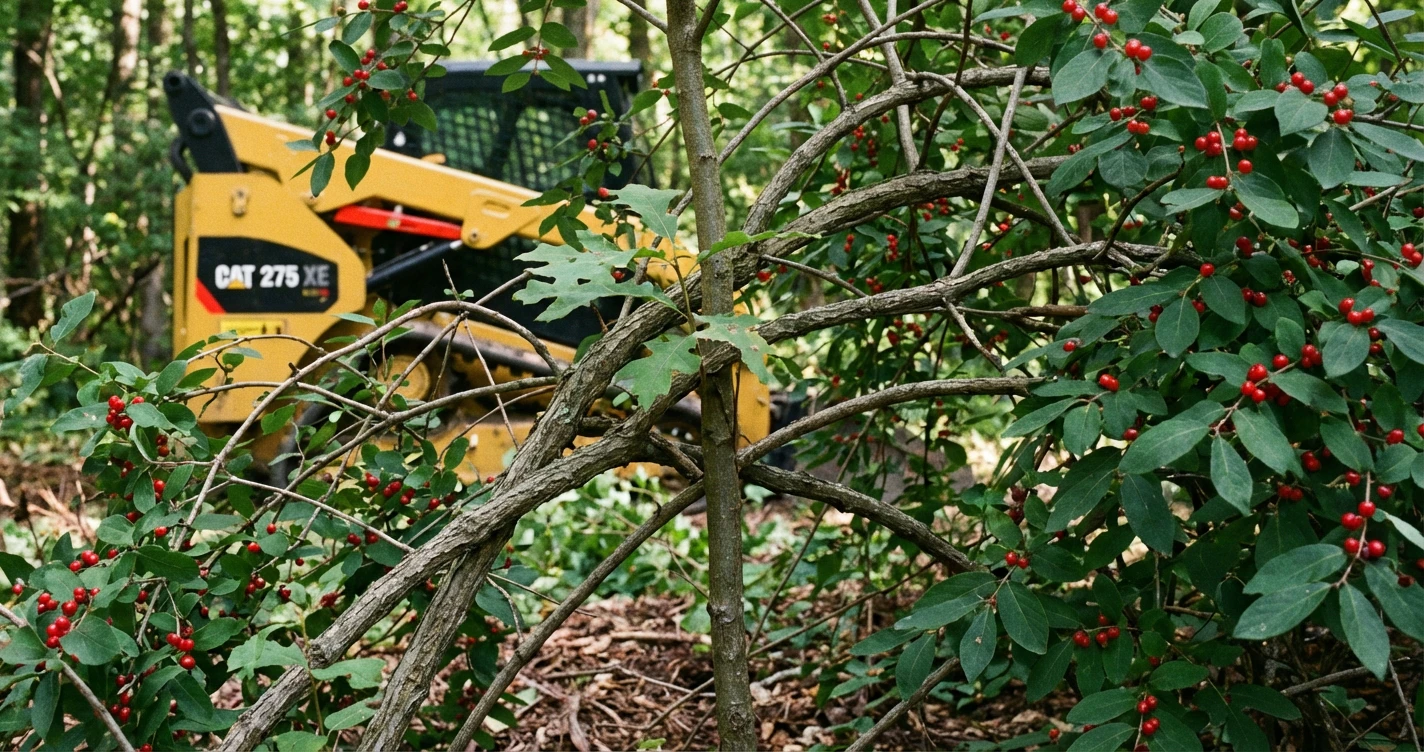
The Monoculture Threat Bush honeysuckle is an ecological crisis because it leafs out earlier than native species, stealing sunlight and water before oaks and maples wake up. In our assessments of Bainbridge Township woodlots, we consistently find that areas under honeysuckle canopies have near-zero native regeneration. The plant also releases allelopathic chemicals into the soil that inhibit the growth of other plants, effectively poisoning the ground for its competitors.
Impact on Russell Village Topography Russell Village is defined by its rolling hills and ravines. Honeysuckle loves these well-drained slopes. We have seen properties where the view of the Chagrin River valley is completely obliterated by a wall of invasive brush. Clearing this restores the “view sheds” that give Russell estates their high market value.
South Russell and Newbury Challenges In Bainbridge, the density of honeysuckle creates damp, dark environments that harbor ticks and mosquitoes near residential zones. In Burton, the agricultural edges suffer as honeysuckle creeps into pastures and reduces usable acreage. The loss of land utility is a direct financial hit to property owners, making removal not just an aesthetic choice, but an asset preservation strategy.
The CAT 275 XE Advantage: Why Residential Equipment Fails
Hydraulic Power vs. The Green Wall The CAT 275 XE Land Management Edition is superior for invasive species removal because it delivers high-flow hydraulic power specifically tuned for continuous mulching. Unlike standard excavators or skid steers that overheat when grinding dense hardwoods for hours, the 275 XE is engineered for 100% duty cycle in forestry applications. This means we don’t stop to let the machine cool down, ensuring your project stays on schedule.
Ground Pressure and Soil Preservation One critical factor in Geauga County is the clay-heavy soil, which is prone to rutting. The CAT 275 XE is designed with a specialized undercarriage that distributes weight evenly. In our operations, we have found that this machine exerts less ground pressure per square inch than a standard pickup truck. This allows us to work in the sensitive woodlots of Burton and Russell without destroying the forest floor or creating mud pits that require expensive remediation.
The Equipment That Makes the Difference: Cat 275 XE Land Management + HM418 Mulcher
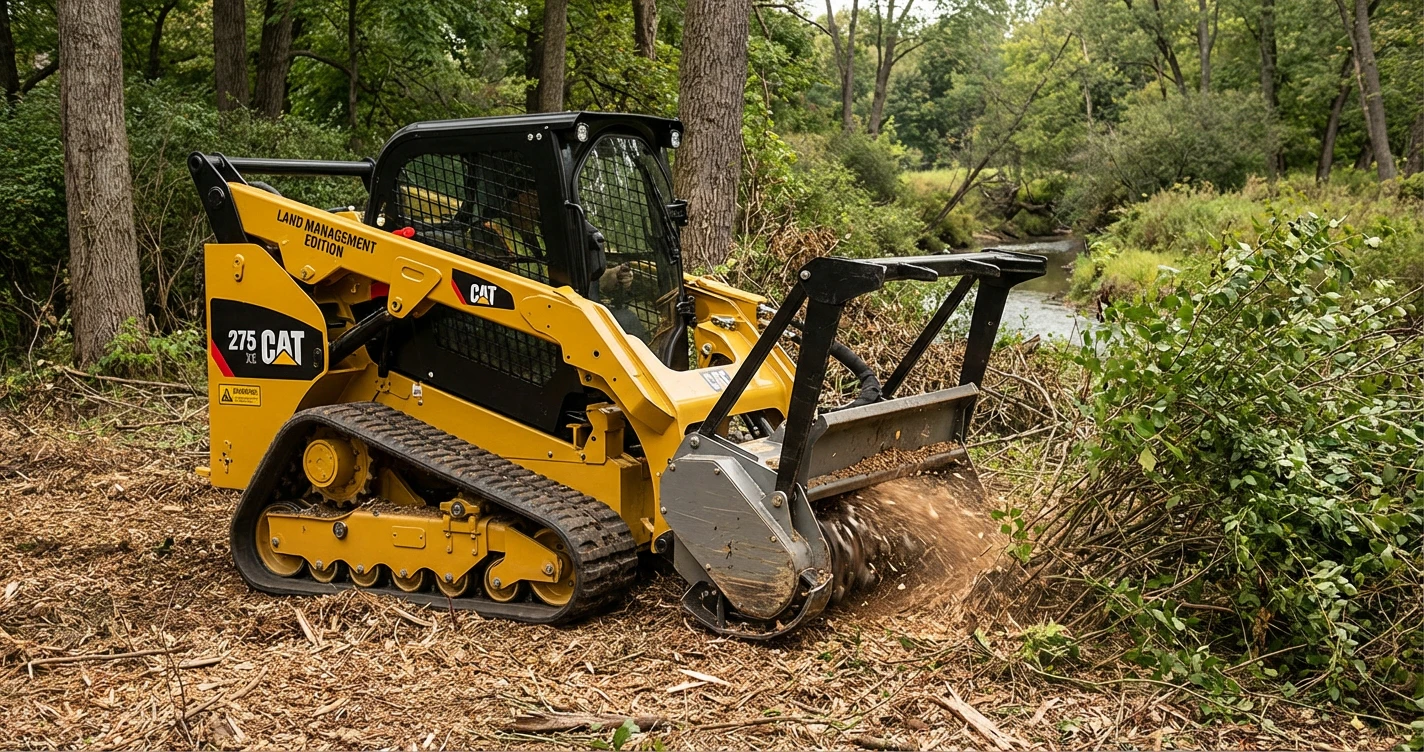
At BrushBoss, we don’t show up with a landscaper’s skid steer and a brush cutter bolted on. We run a Cat 275 XE Compact Track Loader with the Land Management package — Cat’s next-generation platform built from the ground up for vegetation destruction. It pushes 134 gross horsepower and 406 lb-ft of torque through an XE High Flow hydraulic system delivering 40 gallons per minute at up to 4,496 psi — the highest auxiliary hydraulic output Cat puts in a compact track loader. That’s 50% more torque than the previous generation, paired with Cat’s new E-bar undercarriage that keeps 3,200 pounds of mulching head rock-solid on Geauga County’s uneven terrain. This machine was purpose-built to carry a mulcher into the worst brush you’ve got and not flinch.
The Cat HM418 High Flow Mulcher is where your honeysuckle problem ends. Inside that head, 38 fixed carbide teeth spin at over 2,100 RPM on a dual-speed axial piston motor that automatically adjusts torque as material loads change — light saplings, dense six-inch stems, it doesn’t matter. It processes brush up to 8 inches in diameter and grinds up to 4 inches below ground level, chewing past the root crown where regrowth starts. This is nothing like a brush hog, which leaves dangerous punji sticks and does nothing to the roots. The HM418 shatters everything into a fine, nutrient-rich carpet of mulch — safe to walk on, suppresses regrowth naturally, and feeds your soil instead of filling a dumpster. We do in a few hours what a manual crew spends days dragging, stacking, and hauling. No burn piles. No mess. Just clean ground.
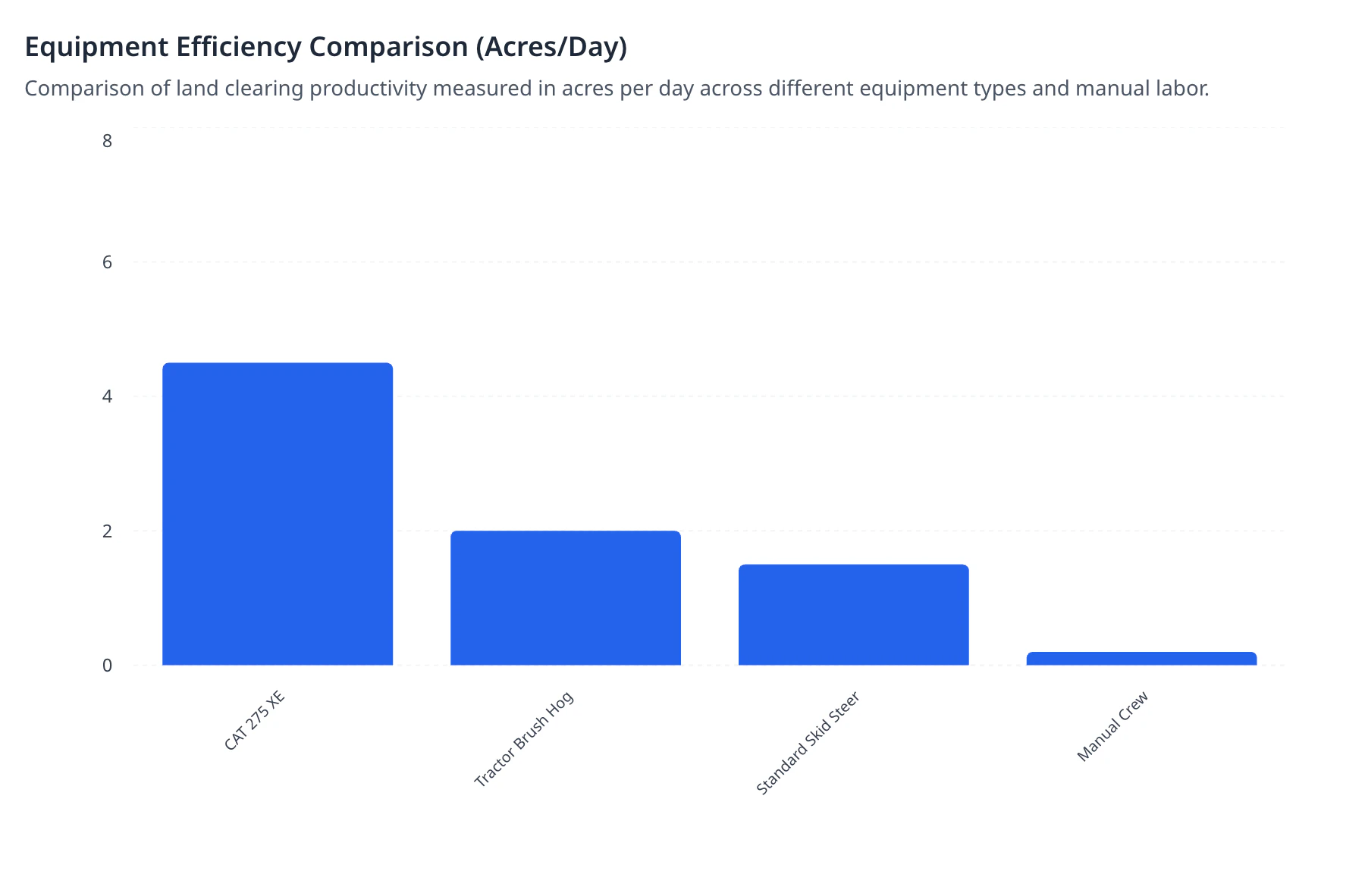
Comparison of land clearing productivity measured in acres per day across different equipment types and manual labor.
Localized Removal: Russell, Bainbridge, and Burton Village Strategies
Clearing the Dense Estates of Russell Village
In Russell Village, the challenge is often access and slope. The CAT 275 XE’s boom reach allows us to clear steep ravines from a safe, stable position on flat ground. We recently tackled a project off Chillicothe Road where the honeysuckle had colonized a 40-degree slope. Manual crews could not safely footing the area. Our machine reached over the edge, grinding the brush down to the soil line without disturbing the bank stability.
Managing Riparian Buffers in Bainbridge Township
Bainbridge features many waterways and tributaries feeding the Chagrin River. Forestry mulching is the preferred method here because it creates zero soil disturbance compared to bulldozing (grubbing). By leaving the root structure of the honeysuckle to rot underground, we maintain soil stability along creek beds while removing the above-ground biomass. This prevents the erosion events often associated with traditional land clearing.
Reclaiming Pasture Edges in Middlefield Village
For our clients in Burton, the focus is often reclaiming lost acreage. We treat the perimeter of agricultural fields where honeysuckle has encroached 20-30 feet inward. The CAT mulcher is precise enough to grind invasive brush inches away from valuable fence lines or historic stone walls without causing damage. This precision restores the full square footage of the property, directly increasing its utility.
Forestry Mulching vs. Manual Removal: A Permanent Solution?
When considering what is the best way to remove honeysuckle in Geauga County, property owners typically weigh three options. Our data shows that forestry mulching offers the best balance of speed, cost, and ecological health.
| Removal Method | Speed (Acres/Day) | Soil Disturbance | Immediate Aesthetics | Long-Term Cost |
|---|---|---|---|---|
| Manual Pulling | < 0.25 | High (Soil disruption) | Good | High (Labor intensive) |
| Chemical Only | N/A (Seasonal) | None | Poor (Dead standing brush) | Medium |
| Forestry Mulching (CAT 275 XE) | 3.0 – 5.0 | Low (Mulch layer added) | Excellent | Low (Efficient) |
The Mulching Advantage Manual removal is grueling and slow. Pulling large shrubs disturbs the soil, bringing dormant weed seeds to the surface. Chemical-only approaches leave “skeletons”—dead, gray bushes that remain an eyesore and a fire hazard for years. Forestry mulching with the high flow CAT 275 XE solves both problems: it removes the visual obstruction instantly and creates a mulch layer that suppresses new germination.
According to visual guides on removing invasive bush honeysuckle, the mechanical destruction of the root collar is critical. Our mulcher grinds the stump flush with the ground, shattering the vascular system of the plant. While not a systemic chemical kill, this mechanical trauma kills the majority of mature plants instantly.
The BrushBoss Field Report: Real-World Geauga County Case Studies
Project 1: The Russell Jungle (5 Acres) We were contracted to clear a 5-acre parcel in Russell Village that had been untouched for 15 years. The honeysuckle was so dense that the homeowner could not walk more than 10 feet into their own woods.
- Challenge: Heavy clay soil and mature trees that needed protection.
- Execution: Using the HF CAT 275 XE LM, we surgically removed the invasives around 100-year-old oaks. The low ground pressure tracks prevented rutting despite a wet spring.
- Result: The property transformed from a jungle to a park-like setting in two days. The client gained access to a rear creek they hadn’t seen in a decade.
- Project 2: Bainbridge Commercial Perimeter
- A commercial facility in Bainbridge needed to clear a security perimeter. The dense brush was hiding unauthorized access points.
- Challenge: Proximity to a parking lot and high visibility.
- Execution: The directional control of the mulching head allowed us to direct debris away from parked cars. We processed the material into a fine mulch, leaving a manicured edge.
- Result: Enhanced security and curb appeal. The “Boss-level” finish meant no cleanup crew was needed after we left.
Project 3: Historic Burton Property A historic estate in Burton needed to clear invasive borders without damaging ancient stone walls.
- Challenge: Precision required to avoid infrastructure damage.
- Execution: The HF CAT 275 XE’s LM hydraulic sensitivity allowed the operator to grind brush within inches of the stone walls without contact.
- Result: The historic hardscaping was revealed for the first time in generations, adding immense character and value to the estate.
Frequently Asked Questions About Honeysuckle Removal in Ohio
How did Amur honeysuckle get to Ohio?
Amur honeysuckle (Lonicera maackii) was introduced to Ohio from Asia in the late 19th century as an ornamental plant and for erosion control. It escaped cultivation due to its abundant berry production, which birds disperse widely. Today, it is a prohibited noxious weed in Ohio.
Why is bush honeysuckle a problem?
Bush honeysuckle is a problem because it outcompetes native vegetation for light and nutrients. It leafs out early, creating a dense shade that kills wildflowers and tree seedlings. Additionally, its berries are carbohydrate-rich but low in fat, providing poor nutrition for migrating birds compared to native berries.
What is the best time to remove bush honeysuckle?
The best time to remove bush honeysuckle via forestry mulching is late fall through winter. During this time, the ground is frozen (reducing soil impact), and the lack of leaves on native trees makes visibility better for the operator. However, the CAT 275 XE allows for year-round removal thanks to its low ground pressure.
Are peaches and cream honeysuckle vines invasive?
“Peaches and Cream” is a cultivar of Lonicera periclymenum, which is generally considered non-invasive compared to the bush varieties like Amur or Morrow’s. However, care should always be taken. The primary threat in Geauga County is the bush variety, not the ornamental vines.
How much does professional forestry mulching cost in Geauga County?
Professional forestry mulching costs in Geauga County typically range from $2,500 to 3,900 per day, depending on density and terrain. While this daily rate is higher than a manual crew, the CAT 275 XE clears 10x the area in the same time, making the cost-per-acre significantly lower.
Limitations and Maintenance: What to Expect Post-Clearing
The Reality of the Seed Bank Forestry mulching is the most effective reset button for your land, but it is not magic. The soil in Geauga County is often loaded with millions of honeysuckle seeds deposited over decades. Once we clear the canopy and sunlight hits the forest floor, these seeds may germinate.
The Boss-Level Maintenance Plan To ensure the “permanent” results we promise, we recommend a follow-up strategy. This usually involves a simple mowing or spot-spraying of new sprouts one year after the initial clearing. Because the heavy brush is gone, this maintenance is inexpensive and easy. Neglecting this step can allow the infestation to return, undoing the investment. We provide guidance on how to manage this transition from “clearing” to “stewardship.”
Restore Your Geauga County Property to Its Former Glory
Invasive bush honeysuckle is a solvable problem when you apply the right force and technology. BrushBoss combines the raw power of the High Flow CAT 275 XE Land Management Edition and CAT’s matching HM 418 Smart Mulcher with a craftsman’s eye for detail, delivering results that manual crews simply cannot match. For property owners in Russell, Bainbridge, and Burton, the choice is clear: live with the green wall, or take back your land.
Ready to see your property’s true potential? Request an Estimate and let us bring the Boss-level finish to your woods.